The Most Common Leadership Blind Spots
AI is transforming how organizations work but leadership remains the greatest competitive advantage. In this article, I explore the five leadership blind spots I most frequently uncover through 360-degree assessments, why they become even more significant during AI transformation, and the leadership competencies today's executives need to lead with confidence through change.
SERIES 1: LEADERSHIP BLIND SPOTS AND SELF-AWARENESS
Chris Patzwald
7/3/20264 min read
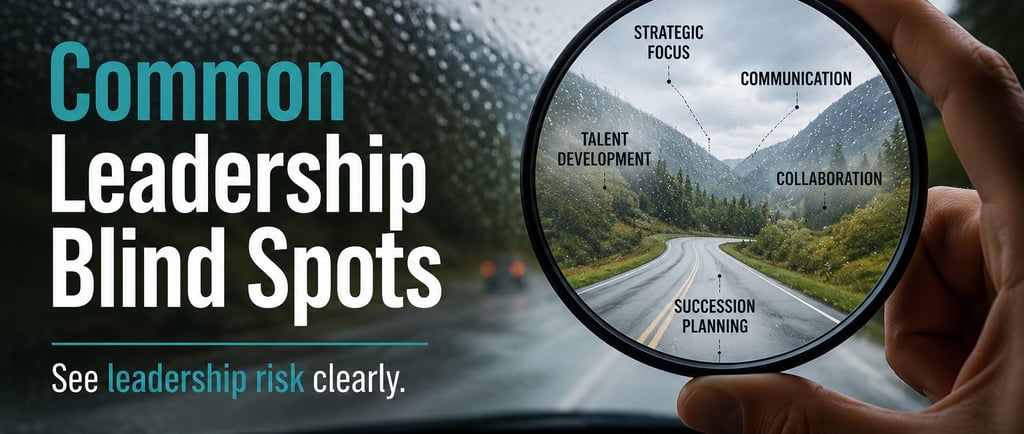
Since 2012, I have conducted 360-degree leadership assessments for executives across industries and organizational levels. While every leader is unique, the leadership blind spots that emerge are remarkably consistent. In this issue, I explore the five leadership blind spots I encounter most often and why they have become even more critical as organizations navigate AI transformation.
The encouraging news is that blind spots are not permanent. When identified early, they can be developed before they evolve into significant business risks, affecting culture, engagement, innovation, succession planning, and organizational performance.
Are leadership blind spots common?
The short answer is yes.
According to Management Research Group's (MRG) 2024 global study of nearly 40,000 leaders who completed a 360-degree assessment, leaders average 7.6 blind spots across 22 leadership dimensions, regardless of management level, geography, gender, industry, work environment (remote, hybrid, or in-person), or generation.
"Leaders have an average of 7.6 blind spots out of 22 measurements."
This finding reinforces the strategic value of helping leaders see what they cannot see themselves.
Leadership blind spots matter because leadership shapes culture.
A 2025 Great Place to Work article, Why Leadership Needs to Back Company Culture, states:
"Leadership support helps turn culture into a shared business priority. When leaders actively back trust, feedback, and employee experience, culture becomes stronger and more consistent across the organization."
In every 360-degree assessment I have conducted, with response rates exceeding 85%, blind spots have been identified, either for the leader, the Board responsible for evaluating executive performance, or both.
In today's environment of organizational transformation, AI disruption, employee disengagement, and quiet or stay quitting, organizations benefit from objective data gathered from multiple perspectives. Effective 360-degree assessments combine quantitative ratings with qualitative feedback and confidential interviews involving managers, peers, direct reports, and external stakeholders. Over time, this creates a meaningful benchmark for measuring leadership growth while identifying emerging risks before they affect organizational performance.
Across hundreds of assessments, five themes consistently emerge.
1. Strategic Orientation
Is the leader spending too much time working in the business instead of leading the business?
360-degree feedback reveals whether leaders are balancing operational demands with long-term strategy and whether employees understand the organization's direction.
Business impact: Strategic alignment improves organizational performance, innovation, agility, and competitive differentiation.
Relevance to AI[1]: As AI automates more operational work, strategic judgment, systems thinking, and critical decision-making become even more valuable. Leaders who cannot elevate their thinking risk slowing organizational transformation.
2. Talent Development & Delegation
Does the leader empower others, or continually dive into the details?
This area uncovers whether leaders effectively delegate responsibility, develop accountability, and intentionally create stretch opportunities that prepare future leaders.
Business impact: Organizations that invest in leadership development build stronger succession pipelines, increase innovation, and improve employee engagement.
AI relevance: AI transformation requires continuous reskilling. Leaders who coach, develop, and empower others will determine whether their organizations successfully adopt AI or simply invest in technology without changing capability.
3. Communication
Do employees experience the leader as open, transparent, trustworthy, and willing to have courageous conversations?
Communication remains one of the strongest drivers of trust, engagement, and organizational culture.
Business impact: Effective communication strengthens collaboration, improves decision-making, and enhances both employee and stakeholder experiences.
AI relevance: During periods of uncertainty, leaders must communicate with clarity, transparency, and empathy. Employees rarely fear technology as much as they fear uncertainty.
4. Succession Planning
Is succession planning a living strategy, or simply a name on an organizational chart?
Strong leaders intentionally identify successors, develop future capabilities, and prepare the organization for leadership transitions long before they become necessary.
Business impact: Robust succession planning protects organizational continuity, reduces leadership risk, and minimizes the cost of unexpected turnover.
AI relevance: Future succession plans must evaluate AI literacy, digital leadership capabilities, adaptability, and the ability to translate AI into better business decisions.
5. Collaboration
Does the leader actively seek diverse perspectives—or unintentionally create the HiPPO (Highest Paid Person's Opinion) effect?
When leaders speak first, others often contribute less. Valuable ideas remain unheard, innovation slows, and decision quality suffers.
Business impact: Leaders who intentionally seek input from subject-matter experts consistently make better decisions while strengthening employees' sense of purpose by ensuring people feel seen, heard, and valued.
AI relevance: Organizational transformation often creates polarization and uncertainty. Leaders who encourage healthy debate, psychological safety, and diverse thinking will build organizations that adapt faster and innovate more effectively.
Leadership blind spots are business risks.
Leadership blind spots are far more than a leadership development issue, they are a business risk management issue.
Boards, CEOs, CHROs, and investors all have a vested interest in ensuring leaders possess the capabilities required to navigate an increasingly complex business environment.
The organizations that thrive over the next decade will not necessarily be those with the most advanced technology. They will be those whose leaders have the self-awareness, adaptability, and courage to recognize and address their own blind spots.
One of the most effective ways to reduce leadership risk is to identify blind spots early, before they undermine culture, engagement, succession, innovation, and business performance.
As AI reshapes how organizations operate, leadership capabilities will become an increasingly important competitive advantage.
If you are responsible for leadership performance, ensure that includes up-to-date categories and competencies.
In my next article, I'll explore why many high-performing individual contributors struggle when they transition into leadership roles and what organizations can do to help them succeed.
[1] The section on “Relevance to AI,” is adapted from the Harvard Business Impact Study 2026 entitled “Global Leadership Study.” The study involved 1,139 senior leaders. Almost half of respondents came from an organization with an employee size of 20,000. 49% of respondents came from organizations with annual revenue of at least $10B.